Who Gets Indicted and Who Does Not: The Hidden Power of the Prosecutor
Who Gets Indicted and Who Does Not: The Hidden Power of the Prosecutor
R. Tamara de Silva
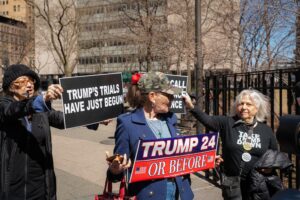
This week saw another superseding indictment for Sam Bankman-Fried, and the first ever indictment of a former United States President, Donald J. Trump by a Manhattan grand jury. While the world seems divided about the latter, some in absolute glee and others who are outraged, this may be a good time to discuss what the power of indictment means.[i]
However one stands on the issue, it should be noted that an indictment is a mere accusation. An indictment is not an indication of actual culpability or a judgment of guilt. Even if you hate former President Trump, in our American justice system, he remains cloaked under the presumption of innocence, as much as anyone else who is or has ever been indicted.
An indictment is also not the result of an adversarial proceeding where both sides are heard. Indictments arise out of grand jury proceedings in which only one side is heard, the prosecution. Grand jurors only hear the evidence the prosecution puts before it. Defense counsel, the media, targets of an investigation, and the public are not allowed to be present. Grand juries tend to indict based on the evidence presented before them by the prosecution.
The process of conducting grand jury proceedings is determined independently by each state in the United States. While the United States Constitution’s Fifth Amendment grants the right to a grand jury indictment in felony cases, this protection has not been extended to the states and therefore does not apply to state-level prosecutions. Nevertheless, several state constitutions mandate grand jury indictments in specific cases and define the grand jury’s powers. Hence, the practices surrounding grand juries vary depending on the jurisdiction, whether state or federal.
And about that, a thinking person will undoubtedly observe that certain individuals are prosecuted, and some, though they engage in the very same conduct, are not. The authoritative allocation of right and wrong lies not just in a black letter reading of a criminal statute, but largely in the discretion of the prosecutor’s office to indict or not to indict. It also affects who gets a plea bargain and who is punished for causing the government to go to trial. For example, if an individual is arrested for the possession of cocaine, the prosecutor can charge the person or dismiss the case, even if there is sufficient evidence to prove the case. They can determine the charges, which will affect the sentence and likelihood of bail. They can also determine who gets a plea bargain and who does not. Due to mandatory minimum sentencing laws and sentencing guidelines, judges are required to impose a fixed sentence based on restricted, charge-based information. So the initial charging instrument is determinative of the result of a case. No member of the judiciary or the public can question a decision made with complete secrecy.
Prosecutorial discretion is what makes the office of the prosecutor the most powerful in the criminal justice system. Moreover, the most critical prosecutorial choices occur privately, away from public oversight, rendering them exempt from public accountability. What is striking about these decisions, which can have life-or-death consequences, is their complete discretionary nature. This is also, though, a political office, an elected office reporting to the executive branch of government.
This prosecutor’s power is impressive, and it is also unchecked. Prosecutors enjoy near absolute immunity from civil suits for alleged wrongdoing. For example, if a prosecutor knowingly uses perjured testimony, coerces a witness, or withholds exculpatory evidence from the defense, the victim of this misconduct is largely out of luck due to immunity.
Governments have used this power to silence journalists for reporting on wrongdoing (Julian Assange). They have used this power to silence influential critics, like Nelson Mandela, Gandhi, Martin Luther King, Eugene Debs, and Ernst Thalmann, among others.
Some entities pay fines for financial misconduct that other individuals are incarcerated for, think of market manipulation. Individual traders are indicted and have gone to jail for charges of market manipulation like spoofing. But have you ever seen a bank go to jail for engaging in market practices that artificially impacted market price? The same behavior, but even the fines imposed are disproportionately smaller for the institutional actor than the individual. This topic and its examples could fill an entire book, as they are far too numerous to list and sometimes even remarkable in their disparity.
This week the U.S. Department of Justice for the Southern District of New York issued another superseding indictment for Sam Bankman-Fried on charges of allegedly bribing a Chinese official. SBF and FTX also made millions of dollars in donations to sitting politicians on both sides of the aisle. It is fair to question whether any of these politicians accepted a bribe or merely a donation. We would not think of it as a bribe without an indictment. One is the grease for the political machinery, and the other an allegedly more stark quid pro quo. But to be fair, both are given, whether to domestic or foreign politicians, to exert influence, and neither is considered charitable.
Rightly or wrongly, sitting cabinet members of administrations receive speaking fees and consulting fees from the same industry participants they will oversee and whose actions they will impact when in office. This is arguably unavoidable and part of the political system, or it is a symptom of the inherent conflicts of interest that comprise the revolving door between private interest and public office in Washington.
Because the office of the prosecution possesses extensive and largely unfettered discretion, it carries greater power and influence than any other office in the criminal justice system. These choices, especially during charging and plea-bargaining, have significant implications for criminal defendants and victims alike, and are often determinative of outcomes. However, the arbitrary nature of prosecutorial decision-making, combined with the absence of meaningful oversight, frequently leads to disparate treatment of similarly situated individuals. It is therefore a matter of grave importance that the political use of the prosecutor’s office, however strongly the winds of political whim may blow, is constrained.
R. Tamara de Silva, Esq.
[i] This article will not discuss the specifics of the case against former President Trump, as the indictment remains sealed.